From Rivas, it is a six hour journey by Tica Bus (1st class bus) to San Jose, Costa Rica. Uneventful, except for the pain in the ass border crossing. Leaving Nicaragua is not so bad. We had over our passports to the driver and he returns with them a half hour later. Entering Costa Rica however involves queueing up in the sweltering heat for 45 minutes just to be able to enter the office. Inside they barely look at us as they slam stamps onto our travel documents. Then we have to line up with all our luggage and wait for an inspector to come by. When he finally shows up, he tells Aidan and I to leave before we can unzip our backpacks. We laugh that he took one look at us and knew our packs were full of dirty gringo backpacker clothes. I wouldn´t blame him. Traveling in this kind of heat makes you pretty grubby.
...........
It is raining when we arrive in San Jose. It is like we don´t want to be here and the city does not want us either. Outside the station, the usual crowd of taxi drivers is waiting. We haggle a bit with one of the drivers and finally arriving on a price, Aidan checks that it is in colones not dollars. The driver nods. A few minutes later we arrive at our hostel. Suddenly the price is dollars not colones. Aidan finally throws him less that what he is trying to charge, but more than we had thought it would be and gets out of the cab.
Our hostel is a massive place with free internet, tv room, call center, bar and restaurant and swimming pool. The next day we by some supplies and mail packages, but it rains again and we use it as an excuse to hide out in the hostel, away from the city that has been unfriendly to us.
.........
Up earlier the next morning for a shuttle to the airport. In a few hours, we are lifting into the sky away from central america and toward the southern end of the americas. A bittersweet ending. It is like leaving for the first time all over again. We´ve become comfortable here over the past two months. We understand the general system, food and brand names becoming familiar. Journeys that involve several different types of transportation and multiple connections don´t intimidate us. We get by well enough in spanish and learn new words and phrases every day. South america could be exactly the same or completely different, who knows what we are getting ourselves into. Whether or not the decision to book half our flights ahead of time was a good idea or not is still a mystery. We did save ourselves money, but we also missed place and whole countries we would have loved to see. In the end it keeps us moving, there is a good chance we would still be in Guatemala if we didn´t have this deadline, so maybe we are really seeing more?
Tuesday, April 29
leaving central america


Saturday, April 26
San Juan del Sur
 Bay of San Juan del Sur
San Juan del Sur sits on a tiny protected bay near the Costan Rican border. Well-known surf beaches dot the coastline above and below the small town. The hills separating it from the rest of the country, provide beautiful vistas for relatively rich gringo´s to build houses on. The idyllic location, laid-back nature of the locals and stream of travelers have given rise to a strong ex-pat community. Some backpackers hate it here because of the foreign presence, but I find it to be a nice mix. And it is a mix. The most popular bars are crowded with Nicaraguans and travelers. Other places we´ve have had a strong separation, but here people seem to get along, able to share a few beers together. Of course, this is just my humble opinion from the few days we spent there. There are definitely the glaring differences in wealth. Ask a local who owns all those modern houses on the hill, and they will not tell you it is Nicaraguans who have climbed the economic ladder to reach those heights.
..............
After a day spent in the gentle waters of the half moon shaped bay, we feel brave enough to take on surfing. Aidan arranges for some lessons off a sign in front of one of the many restaurants lining the shore. The next morning we meet the genial Geraldo (from San Juan) and Kattrin (aus Deutschland). They load us in their pick up and we drive to Maderas, a beach north of San Juan. Along the way, they meet an American friend of their´s, Crazy Dave. Crazy Dave is probably in his late 40´s and owns a ¨surf hotel¨between Maderas and Majagual beaches. Dave is driving ahead of us when his jeep suddenly stalls on a hill. He backs it into a turn out and gets in the truck with us, cursing his mechanic for the rest of the trip. Later it turned out he had actually run out of gas with out real zing it.
At Maderas, Geraldo takes charge of Aidan and Kattrin looks after me. They carefully pick out good waves for us, tells us when to hop on the long boards, and then give us helpful pushes while shouting ¨paddle! paddle!¨Living the majority of my life near the pacific ocean, you would think at some point I would have at least sat on a surf board. However, I´d always had the impression it would be extremely difficult and the culture of surfers would be intimidating to learn around. It turned out not to be all that bad. It is difficult, but we both managed to stand up and ride along on the white water. And people seemed to be pretty cool about these awkward, ungraceful beginners sharing the water with them.
 Janis surfing after one hour lesson
The beach itself is beautiful. Clean, lovely white sand, low cliffs overlooking the jutting rock formations. An unsturdy looking restaurant/bar/hostel stands to feed and house grubby surfers and beach goers.
After a couple hours of our new found hobby, Geraldo and Kattrin say they are going to head up to Crazy Dave´s house for lunch and we can come with. We jump in thinking we´ll check out his hotel and see if we want to stay a night here at the beach. ¨The Hideout¨over looks Matlida beach. The ground floor had a kitchen, a few tables, and a wide open entrance giving it a semi outdoor feel. A swirling staircase in the back leads to the dorm of three double beds and one ¨private¨room. The whole place is half finished. The private room has a screen sloppily stapled over it, and a doorway (with no door in it) to a balcony of loose boards. Still it´s a great location and the price is right. We put down money for a dorm bed. Crazy Dave says we´re the only ones booked in and will probably have the place to ourselves.
A few more hours of surfing as Aidan and I call it - or standing up and falling over as others might - and then we head back to San Juan. That evening we hike up to the fancy modern hotel Pelican Eyes. A couple nights a week they have a cheap happy hour. You can sip a drink while watching the sun dye the sky red as it drops into the ocean. The west coast girl in me realizes the only proper sunsets are over the sea. On the way back to the hotel, we meet our french friend Mathilde and her mother who joined her in Nicaragua for a few weeks. San Juan will be our last official stop in Central America and it is only fitting that to run into Mathilde one last time. sunset over the pacific
 view from the Hideout
That night we get to know everybody over dinner. Crazy Dave serves a set dinner for c$150 which is a pretty damn pricey. We figure we are kind of stuck unless we want to hike back down to Maderas. It is a decent spaghetti bolognese, but Murio is more than disappointed. It seems Dave has been telling him all day that there would be fillet mignon for dinner and Murio had his heart set on a nice steak dinner. Turns out the filet mignon was used for the bolognese. As the sun goes down groups of howler monkey´s make their calls. They sound closer than ever before. I think about that open doorway to our bedroom. Crazy Dave tells a few random, borderline racist stories, before going upstairs with Ben´s two friends. They had stayed in the private room the night before because the third bed in the dorm didn´t have a mosquito net. We´ve come along and stolen the private room so Dave needs to sort out the net. Apparently, he is up there for about half an hour before giving up and the couple sleeps with the net literally draped over them.
They all go to bed, leaving Ben, Murio, Aidan and I up. The beer in the fridge is on an honor system. We sit on the concrete porch, chatting and watching red and purple crabs scuttle sideways across the floor. Ben and Murio are characters for different reasons. Murio is a gentle bus driver for a European tour company with a long pony tail and round glasses. He is a good few years older than us. He´s been traveling for six months in South America and plays us reggae music he has collected on his travels. Ben is our age and has been volunteering in Peru and Nicaragua for the past year. The more beers, the more animated he gets. It´s a good night.
............
We are the first ones up the next day. Well, actually Ben is the first one up and plays a few Bob Marley songs on his ipod speakers before falling back asleep. To get to the bathroom we have to go through the dorm and open the creaking door, I´m sure much to the annoyance of the others. We decide to pack up, one night at the Hideout being enough for us. During the night we discovered the mosquito net had holes in it and there is a nest of wasps under the bed. We manage to escape without any bites or stings. Downstairs we settle up with Dave. He tries to charge us extra for the private room but relents when we argue we had no choice but to sleep there. It is a 15 minute walk along the water to Maderas where we can catch a shuttle later back to San Juan. In the meantime we rent a surf board for another go at the waves. This one is much shorter and much more slippery. Aidan manages to stand a few times, but I can´t seem to get up. It doesn´t help that both my knees are purple from the effort the day before.
 Aidan on day two of surfing
Friday, April 25
a close one

Puno, Peru. May 25
The bus from La Paz (Bolivia) to Cusco (Peru) is 11 hours, allegedly. After 6 hours, we arrive in Puno, where some people are getting off. "Five minutes for toilet break¨, the driver announces. So we get off, go into the bus terminal and use the toilets. Then we make a quick phone call to a hotel to try to reserve a room for the night. We wouldn´t normally book ahead, but it´s peak season in Cusco, and since we arrive at 9pm it would be nice not to have to look round for somewhere to stay.
Of course there is a problem with the payphone and I get cut off, so I try again (bad decision). After failing the second time we leave it and head out back to the bus except... the bus is gone - along with all our stuff. A big empty space where the bus had been. We ask a woman wearing a uniform where the Cusco bus is - "around the corner I think". We run, while I curse like a madman. There is no bus around the corner. We ask another woman in uniform ... she points back to where we had come from. Janis cleverly asks where the desk for the bus company is. (Each company has a desk in the terminal.) We eventually find it, and the guy mumbles that the driver doesn´t have a phone. He slowly walks outside, and we follow him to the taxis, where he debriefs one of the drivers.
So away we go zig-zagging around the fruit stands, tuk-tuks, and wandering toddlers, and then arrive at a road block. The driver reverses and tries another route. He keeps blessing himself when we pass a church, or a traffic light, or just about anything. 'Less blessing, more driving', I´m thinking. After fifteen minutes we see our bus in sight, crawling up the hill at about 15 miles an hour. We´re in hot pursuit at about 20 miles an hour. It´s like a tortoise trying to overtake a snail. We eventually pass the bus, and I stick my head out the window pointing to pull over.
Great, muchas gracias, how much? 10 soles. It should probably have been about 5, but if you don´t negotiate beforehand, you don´t have a leg to stand on. But how do you negotiate a price beforehand when neither one knows how long it will take.. Just delighted to have caught the bus, I pay him and get on the bus. The driver and the co-pilot, seemingly very amused, have the biggest smiles I´ve seen in a long time.
Tuesday, April 22
Isla de Ometepe
From Laguna de Apoyo, we hop the shuttle back to Granada and take a chicken bus to Rivas. On the bus we meet an Australian couple, Kate and Ben, who we share a taxi with to the port in San Jorge. The port is dismal with long, grey beaches and straw shade huts stretching out on either side. A light smattering of trash liters the water´s edge. We board a lancha for the a 1hr trip to the islands of Ometepe. This is not quite the lancha we´re used to, bigger, more like a ferry. We sit for a half hour in the hot sun waiting to take off, watching young guys load heavy baskets onto the back of a truck.
Isla de Ometepe is formed by two volcanoes rising from the water to kiss the sky above. An accumulated volcanic flow links them creating an hour glass island. The distinctive peaks grow larger and larger. The sharply slanted slopes of the taller volcano, Concepción, is especially impressive, a typical upside down funnel. A gentle cap of fuzzy clouds sits, ever present, on top.
Stepping off the lancha, we are surrounded by taxi drivers vying for our business. We split a cab with Kate and Ben. It is pricey enough at $25, but it is also a 45 minute trip to the other side of the island. We are heading to Playa Santo Domingo which sits on the eastern stretch connecting the volcanoes. The landscape is dry and wild, interspersed with plantain farms, small towns, and even smaller settlements.
 volcanoes of Ometepe
It is a jostling ride down the rutted dirt road. The bus drops us at another rutted dirt road that will lead to Finca Magdelena and we make the sweaty kilometer trek up to the farm. Our private room is not quite sealed from the various flying insects that call the island home, but it is clean and there is a mosquito net. The best part is the bathroom is wall papered with what seems to be tin foil.
Finca Magdelena is a working cooperative of farmers, mostly plantain, who practice sustainable techniques. Most travelers use it as a base to hike up Maderas, the smaller of the two volcanoes. Other than that there is not too much going on. Sitting on the porch overlooking the garden and further on the lake, the heat is broken every once and a while by a sudden strong wind that is gone as quickly as it came. After a quiet dinner it is early to bed, lulled by the rhythmic hum of ciacadas and the far off calls of howler monkeys.
The next day, we have the bright idea of renting bikes from the hotel and riding to Ojo de Agua. This is a man made lagoon fed by a natural river. Sounds like a great relief from the heat. The problem, for me, is getting there. I´m not much of a bike rider and the hours in the sun on the dusty road that rings the island almost causes me to give up. Finally we make it and have a tranquil day relaxing by the water. On the way back a group of ladies who had been at the pools passes in a comfortable looking SUV. When I push my bike up the final stretch to the Finca, the ladies are dining at the restaurant. They look at us in surprised concern. One asks how I´m doing with a friendly smile. I can only manage a red-faced smile and a mumbled ¨tired.¨.
 Aidan jumping into the waters of Ojo de Agua
 Pushing two bikes while Aidan stops for photos
Later we sat at the restaurant playing cards and making friends with the local nature. First a regal, curious looking praying mantis appeared on the back rest of the empty chair next to us. Then a large cicada landed on our table. A chlorophyll green, he would have been perfectly disguised as a leaf on a tree. Here he busied himself marching up and down the edge of the table, occasionally stopping to clean his hair-thin antennae. Our last guest was a small lizard who was hanging off the side of the tablecloth keeping a careful eye on the cicada. The trio kept us company for a couple hours before we bid them goodnight and tucked ourselves in under the mosquito net.
Tuesday, April 15
Laguna de Apoyo
On our friend Jenny from Utila´s recommendation we decided to check out Laguna de Apoyo. We catch the shuttle north from the Oasis Hostel and half hour later we are greeted by an unflappably perky Canadian woman Anne, proprietress of Crater´s Edge Hospedaje. The Laguna is actually a crater lake, kept bathtub warm by thermal vents and kept pristine by the conservationist locals. The tree lined hills slope gently into the water meeting at a rocky shore. The far side looks deceivingly close, but is actually 7km across. The laguna houses only small fish, the biggest about the size if a finger, and motor boats and jet skis have been banned.
I can´t say too much exciting happened in the two days we spent there, but we had an excellent time swimming, eating, lying in hammocks, swimming, reading, and eating. And there was some kayaking in there as well. One side of the dorm room was a metal screen so you could look out onto the lake from bed. Each morning, I´d wake up as the first light flooded in, sit up to watch the sunrise, and then fall back asleep. When we finally roused ourselves again we´d walk the short staircase up to the outdoor patio for breakfast and then back down for a swim to the floating dock. There was a set menu for all the meals of delicious and healthy food. So basically, we didn´t have to do anything for ourselves for two days. It was a welcome break from the constant decision making that is part of backpacking. Which hostel should we stay at? Which bus should we take? Which tour to go on? And every meal we have to decide where we are going to get our food from. After awhile it becomes a rhythm, something you don´t think as much about, like being at work was, but a few days off was worth it. Especially since our bill turned out to be a little more expensive than we´d hoped.
Monday, April 14
Granada
Rocking chairs, lined up in rows, fill the front rooms of houses in Granada. It is another colonial city, but so different from León. Here, there is a long ¨tourist¨street undergoing a beautification project that leaves a coat of dust on everything around it. You have to go into the mercado section to really see the local life. It is a smaller city that was burned to the ground by William Walker, so the buildings are much younger, free from the normal wear and tear you would expect from a former spanish city. It spills into Lake Nicaragua, the largest in central america. Standing at the shore you almost think you are seeing the carribean ocean. What you are definitely not seeing is the beautification project. The land along the water is run down and dirty. Not that you would want to spend much time there anyway, because you are too busy swatting away swarms of white flies that live right by the narrow shore. Hopefully, they are not actually there all year long, but they make it pretty unpleasant when we try to sit and enjoy the view.
..............
We visit the San Francisco Convent which has been turned into a great museum. For a fairly small place, there is a huge range of things to see. Luckily a personal guide is included with the 20 cordoba ($1) entrance fee. There are recreations of some ¨games¨the ingenious people used to play in celebration. They look sort-of like playground rides - one a type of teeter-totter that swung around in a circle with a man clinging onto either end. The other is kind of like a May pole, but where the men were attached to the ropes flying through the air. There is also a long hall of stone carvings found on the Zapetera Island. Most of them depict people carrying animals (like crocodiles) on their back as a form of protection. I love the colorful, one-dimensional Solentiname paintings of busy village scenes.
Next up is a tour around the (non active) crater of Momobacho volcano followed by a canopy tour. We book through Tierra Tours and David is our guide. He really makes the tour worthwhile because otherwise, we realize, it could have been done on our own. The walk around the crater is interesting, but we don´t get to see any sloths, so a little disappointing. We do see lots and lots of butterflies. David spouts off the latin name anytime one flutters by and gets really excited when a particular orange and purple butterfly is near. They believe that it is an endemic species and a currently trying to verify. He has us take lots of pictures of it. Particularly interesting is a point where we are overlooking the city of Granda. As David is naming off the different landmarks, he mentions that the huge building with the white roof at the edge of the town is a factory. He says ¨A factory. I believe it is called a sweatshop. I used to work there.¨ He is a pretty young guy and such an enthusiastic guide, I am more than a little surprised. He explains that he went to work there before he turned twenty. After a few years, the factory lost a big contract and had a round of layoffs in which David lost his job. He was in charge of watching a line of women sowing the clothing, on his feet for 10hrs a day, with only one half hour break. Overlock sewing machines were used and created a lot of fuzz in the air that the workers breathe in, causing them respiratory problems. I have a feeling what he told us was just the start of the problems. After he lost his job his father helped him go to school to learn english and then he began as a tour guide. He says getting fired saved his life.
After the crater, we go down the volcano a few miles for the canopy tour - a series of 18 zip lines. We get suited up with goofy looking harness, helmets, and gloves and climb a short ladder to the first line. It feels pretty safe, mostly because in addition to David we have four other men making sure our caribeeners are always attached to something secure. Apparently, a couple of them are being trained, so we are getting special treatment. One of the older guys takes charge of our camera in the beginning. We were a little nervous watching him slide down the lines with our one and only camera dangling from his wrist, but he carefully recorded our every move. The actual zip line is a thick wire high between two trees. One of the men would clip the rollers (sorry for not having a more technical term) attached to our harness onto the line and off we would go, flying down the line. You could use your gloved hand to slow the descent if necessary. On some the lines, the guides would have us go upside down or they would hold onto our legs so we were in a sort-of superman position. By the end we were all giggly and out of breath, but it was a great time.
Sunday, April 6
León
It´s another early morning so we can catch the bus to León, Nicaragua. In Utila, we realized how quickly the time was going. If we really wanted to we could try to fit three countries (and the Bay Islands) into two months, but the reality is that is not how we like to travel. We don´t want to rush - we want to take the time to enjoy these corners of the world we are lucky enough to visit. A month in Guatemala and we barely scratched the surface. Based on this and the fact that every other traveler we´ve talked to has raved about Nicaragua, we decide to spend our remaining time there. Costa Rica sounds like a fascinating country for different reasons, but it is more expensive. So it will have to wait for our next trip to central america.
Tica Bus is our chosen method for getting across the border. It is a first class bus ride, but it is a six hour journey and they have a reputation for making border crossings easy (not that our last one was hard, but you never know...). The line actually runs to Managua not to León, but the agent explains we can save ourselves an hour by getting off at a town called San Isidira. She advises us to take a microbus which should take an hour. But when the Tica Bus drops us off a chicken bus has conveniently pulled up so we hop on that instead.
The landscape looks like california might have as the settlers from the east were moving west. Dry land colored by non-deciduous dusty green trees and mountians lining the horizon. The bus ride is like the rides people pay for at amusement parks. The driver swerves back and forth to avoid a road riddled with potholes. But that doesn´t stop him from trying to make it in the fastest time possible.
We had a strange experience getting off the bus in León. The station is far from the center of town and it was getting dark so we had decided to take a taxi to the hotel we had been recommended. All the other passengers were out the door and gone by the time Aidan and I got our slow selves off. There was one other guy hanging around who we naturally assumed had been riding with us. The conductor was getting the last of the luggage of the top of the bus. As he passed down the first duffel bag, Aidan started to point to it thinking it was one of our backpacks but then realized it wasn´t and backed off. The other guy grabbed it so we guessed it was his. We got our bags and a taxi driver was already waiting to get us in his cab. Aidan went over the price with him and the guy with the duffel bag joined in so we thought he wanted to split the cab with us. No problem. We throw our backpacks in the trunk and he puts his bag in. Only he doesn´t get in the taxi with us. He stands by Aidan´s window and asks him for a dollar in exchange for helping us with our bags. After some back and forth, we cop on that this guy thought the duffel bag was ours. In my bad spanish I tell the driver that the bag is not ours and get out to show him. The guy is still hassling us for money. The bus driver and conductor are gone. The cabbie says something that sounds like he is telling him to leave us alone, closes the trunk, and we drive off. With the mystery duffel bag. The driver says he´ll take it back to the bus station after he drops us off. I don´t really have any reason not to believe him, but still I´m worried we just aided in stealing someone´s luggage...
We stay at the Via Via Hotel. It is pricier than we expected - $15 per night. Of course this is not actually expensive, but everything is relative here. We paid $16 for a hotel the first night on Utila and the prices are generally much higher there. One look at the room though and we are sold. It is not fancy by any means, but it has a private bath, tasteful decorations, and it is very very clean. The rooms surround a nice garden and there is a restaurant/bar at the front. Another great feature of the hotel is Harrie, a Dutch guy who operates tours out of the hotel.
There is a liveliness to León that we´ve been missing. Utila had a lot going on as well, but Leon has space and choice. It has wide streets and a spacious central plaza. It´s got a variety of restaurants, markets and tiendas, and cheap internet cafes. There are things to do and see that don´t all involve scuba diving.
The first thing we try is volcano boarding. It is run by Big Foot Hostel which is just across the street from us. What is volcano boarding, you might ask. Well, first there is a long, dusty ride in the back of a truck to the volcano, Cerro Negro. Then there is a hot, slippery walk up the volcano dragging a sled-like board with you. At the top of Cerro Negro is the best part in my opinion. It is only 100 years old and is still barren black volcanic soil. The surrounding fields of green, feed by the fertile soil, contrast the landscape sharply. We look down over the edge into the smoking crater, gasping for air amid the sulphiric fumes. Finally it is time for the boarding. An energetic Dutch woman gives us a demonstration that makes it look easy. Donning orange jumpsuits, we sit down on our boards at the top of what suddenly seems like a very long, very steep side of the volcano. It´s my turn and the other guide gives me a little shove. I pick up speed fast and feel the board start to verve to one side. The Dutch woman warned us about this - no problem, she said, just hover your feet off the board on either side and you will even out. No problem, I think, and take my feet off the board. Before I know it, I´m on my side and my board is a few feet ahead of me, sliding down it´s own. I pop up and grab it before it can get too far. On the second attempt I don´t speed up so quickly and apply the braking technique liberally. The brakes being the heels of my boots digging into the loose gravel, which makes the little rocks fly up into my face (we were provided goggles to at least protect our eyes). Pretty soon I´m at the bottom. Most people wipe out so I don´t feel so bad. In all it was an interesting experience, but not as fun as I had expected. If I´d been able to control the board better, I think it would have felt more like boarding and less like sledding.
One of our days in León, Aidan decides to go to a galleria with Harrie from the hotel. I´ll let him explain about that and just say that it probably would have been a very eye opening experience, but not one I could bring myself see.
We also visit the cathedral, which for a few cordobas, you can also take a guided tour of the tower and roof top. Our guide is very friendly and speaks slowly so we can understand. There is a great view of the city from the top. I love seeing the small groves of the trees in the open courtyards of the houses. The Fundación Ortiz is an interesting museum with works ranging from colonial to modern times.
All of our activities are interspersed with lots of hanging around the garden of our hotel. León is even hotter than Utila, although not as humid.
---------------
Our last tour is the best. Harrie offers a day tour called ¨Tree, Church, Fortress¨. And logically, we visit a tree, a church and a fortress. And a cemetery thrown in for good measure. The first up is actually the church. It is a catholic church, one of the 6 or 7 in the city. This is also one of the oldest, but is closed to the public now. Ten years ago the spanish government gave the church money to fix the crumbling roof. Unfortunately, the beams hadn´t been fully cured by the time they were used and started to crack soon after they were put up. So now the church is considered unsafe and sits unused falling into further disrepair.
Next we go to a tamarindo tree in the middle of the indigenous section of town, Subtiava. When the Spanish arrived to this part of Nicaragua 400 years ago, the Subtiavan chief was very powerful and owned all the land for miles around. He didn´t see the Spanish much of a threat, and treated them as equals. He agreed to lease them a section of his land, because he had plenty of it. The spanish signed a document and founded León. When León had grown and gained sufficient importance, the Spanish attacked the Subitavan chief and hung him from this tamarindo tree which was considered sacred to the locals. The story has a twist though. Recently, the government of León is trying to tax the people of Subtiava, who retain a good measure of autonomy. The leaders of Subtiava produced the document that the Spanish signed 400 years previous and demanded that the back rent be paid.
From there we drive to a fortress, originally built by the Spanish, high on a hill over the city. As we get out of the jeep, two scraggly dogs wander over to investigate. They are so thin you could count their ribs. A well-fed security guard sits in a hammock listening to a small radio. I wonder why he couldn´t give these poor creatures at least a little food. Harrie leads us across the parking lot away from the fortress. I immediately regret my early thoughts. We are over looking León city dump. Actually what we are looking at is people digging through the garbage, searching some means of sustenence from the garbage of the city. These are the ones that need help. The government has been trying to move the dump to a new location where it would be modeled after a successful program in Guatemala City. The dump was enclosed to prevent the trash from spreading and the communities that live on them were employed to do some basic sorting. It´s not what might happen in a ideal world, but it is a start. Now they just need to actually do it.
We wander into the fortress. The view over León with a series of volcanoes in the distance is beautiful. The fortress itself is a depressing, difficult place. It was used as a prison during the 43-year Samoza dictatorship. It was actually used as an overflow prison when the main jail was too full. Harrie has compiled stories from men that were here when it was liberated at the start of the Sandinista revolution. It is hard to stand in this place where torture and executions were carried out and know what human beings are capable of. The Samoza reign and revolution that ended it are both fascinating and complicated. Too much so to try to sum up here.
Our last night there is a charity trivia tournament at our hotel. We form a team with David from England and Killian from Switzerland and two of David´s friends. The first prize is a bottle of Flor de Caña, the national rum of Nicaragua and a pretty damn good one. Aided by a few litros of Victoria beer we do our best. There are a few physical challenges in the quiz, one of which sends Aidan sprinting around the block. We miss a question or two in every round, so are not too confident seeing as how there are 20+ teams. After the quiz papers are collected, we are busy socializing when Killian notices that they are calling our team name. Turns out we are tied for first place. We have to elect one member of our team to go in for a sudden death round. We decide on Killian, who goes into the office with his challenger. 10 minutes pass and he is still not out. 20 minutes later, he emerges. We´ve come in second, but not because of any lapse in knowledge by Killian. They were asked two questions. The first they both knew, the second neither did, so in the end they flipped a coin. I hold that we were robbed. The rum was rightfully ours. For second place we got a couple more litros of Victoria. Seeing as how David and his friend had to work in the morning and Aidan and I needed to get ourselves to Granada, it was probably for the best, but still we were totally robbed.
Ok, here is the deal with the photos: they have been a pain in the ass to upload so rather than spend hours in internet cafés with slow connections, I´ll just post them when it is convenient.
Friday, April 4
Utila - the end
Every weekend Alton´s puts on a little party known as the booze cruise. About an hour before sunset, everyone clambers onto one of the dive boats and they head out onto the bay. Dance music is blasted and beer and rum drinks are sold. This is the start of a long night.
After the cruise, we are invited to a party at one of the instructor´s houses. Four of the DMT´s have just finished their training, so it is a big night at Alton´s. I go with Jenny to get some dinner and arrange to meet back up wtih Aidan at the party. It is in full swing by the time we arrive and there are more rum drinks flowing. At the party we get talking to a local guy who is from one of the seven families that run Utila. He tells us that his family has had a long standing feud with the Alton family (same ones who own our school). Apparently, Alton put in a staircase over Bush´s supermarket, the largest market on the island, that reached into the middle of the street. This guy´s brother was riding along in the scooter and ended up crashing into the staircase. He was in a coma for weeks. The family asked Alton to pay for some of the costs, which they refused. So they sued him. On such a small island, it is easy to see how a feud like that could stretch down for generations to come.
Ian, the owner of the house we are at, starts to clear the place at around 11pm. Everyone heads to Treetanic bar for the intiation of the DMT´s. Treetanic could be a whole post in itself. The owner spent years (some people say seven some say way more) crafting the bar, restaurant and hotel. There are archways made out of old glass bottles, temples formed from marbles, and grottos in every little hidden corner. The bar itself is actually in a tree. There is something to look at everytime you turn around. Adam keeps telling us that the owner is insane, but also a good friend of his.
The initation is called the snorkel test. The DMT´s have to put on a mask and snorkel with a bottle attached to it. Some sort of unaturally blue drink is poured into the bottle and the DMT has to then suck it out through the snorkel. I don´t know for sure, but I have a feeling there is a pretty intense drinking culture that parallels the diving cutlure anywhere you go.
-------------
We end up spending two days doing pretty much nothing after our course ends. One day we make it down to a beach on our side of the bay with Jenny and Carolyn - it´s pretty nice but not overly stunning. It has sudenly become very very hot on the island. It was hot to begin with, but this is taken it to a new level. At least it gives us something to blame our laziness on.
------------
For good measure, we decide to do another fun dive before we leave. We pick a morning dive since we didn´t do any during the course. The dives themselves are fine, but in between the dives is when the magic really happens. The captain takes us to the north side of the island for the first one. We are on our way to the second location when someone spots dolphins in the water. As we get closer, we see that they are way too big to be dolphins. And they have no snout. They are pilot whales and apparanetly quite rare around here. There are three of them and incredible to see - so big and powerful, yet so calm, so steady. The captain explains they are attracted by the vibration of the engine. Soon three other boats are swarming around them so our boat heads off. That´s when we spot actual dolphins. Lots and lots of dolphins, probably 70-100 of them. Someone says spinner dolphins. I´m in awe again. They move so quickly and gracefully, leaping from the water and twisting through the air. They are all around the boat, keeping speed with minimal effort. The captian says we can jump in so in a frenzy we grab our snorkels and fins and dive in. They are deep below us. The sound is amazing. You can hear the high pitched communications interspersed with rapid clicks. They seem to play and tease each other as we watch from above. Eventually we climb back in the boat. The second dive is fun but we´ve already had the highlight of the day.
---------------
It´s our last night on Utila but we have to make the 6am ferry so it is a quiet one for us. As we are enjoying our last sunset, Mathlide, our friend from San Pedro and Lanquin, walks up. We had actually had randomly sat down next to her at an internet cafe on our first day, but she was just leaving to go to one of the other islands. So this is the fourth time we have run into her. We have a dinner that starts out nice, but turns painful when we go to pay the check. It takes an hour before the bill is taken care of. One last drink at Treetanic and back to the room to pack.
On our last fun dive, Aidan rented a camera with underwater casing. Check them out here. *Beware - we are beginner divers and getting photos underwater is not as easy as you might hope.
One of these days I´ll get up the photos we took while not in the water...
Thursday, April 3
Utila, cont.

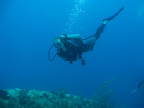
Our open water dives are tough and wonderful all at the same time. They each consist of two dives at two different locations on the same boat trip. They are tough because on the surface the ocean is not a calm, tranquilo place. The waves are usually choppy and while trying to manuver around 15 people in the boat to get my wetsuit, weight belt, fins, mask and BCD on, the sea sickness I used to experince as a kid starts rising through my stomach. It could be worse - I don´t actually get sick or anything, but it makes it hard to enjoy the moment. Once we are all geared up, one of the divemasters (sort-of assitant instructors or dive leaders) or the divemasters in training (DMT, there are a lot of these) help us walk to the back of the boat. It is hard to do on your own with the floppy fins on your feet and heavy tank on your back. And the rocky boat and the slippery floor. Basically it is really difficult and it doesn´t get much easier once you are in the water. You have to find your instructor or leader and then swim over to them without swallowing too much water as the waves roll over you. And then you have to manage not to drift off while the rest of your group gets in.
But finally you descend and then everything is tranquilo. Obviously we have nothing to compare it to, but the reef is awesome. I could spend the whole dive in one place just watching the fish interact and examing the coral. Before we get to enjoy the actual dive though, we have some practice excersices to do. Mostly they are dealing with what happens if you get water in your mask or your mask falls off or your regulator (what you breathe through) gets knocked out. We also have to do a compass navigation excercise and a controlled emergency ascent which simulates what happens if you were out of air and didn´t have someone nearby to share with. My least favorite are the mask excercises as the salt water stings my eyes so badly. I worry that the group is going to take off before I can see properly. We get through it all and then the fun starts. We see so many amazing fish I realize how little I know about fish or marine life at all. We see morey eels, spotted morey eels, scorpion fish, lobsters, garden eels which are little tiny ones that live in the sand, and we see a 4 1/2 ft nurse shark, which is very exciting even for the instructors. We see so much more that I can´t remember it all by the time I get to the surface. The time under the water flies by and all too soon we have to ascend.
Back at the surface we are fighting the waves again, trying to make it back to the boat. Getting in is really tough, the tank feels like it even heavier than before, which is impossible because I´ve used up a good portion of the air. Just to pull myself up the ladder I need help (I only managed to do it by myself once). Before we know it we´ve completed our open water training and are certified to dive up to 18 meters.
As part of the course we get two free fun dives. As you might deduce, these are pretty fun. No more filling your mask with water and taking your regulator out. The most eventful part of our fun dives was before we left the dock. We had been waiting around for Adam to turn up because he was going to get our certifications all filled out and go over the day´s dives. After waiting 45 minutes, Jackie a DMT and our assistant instructor, helps us get our equipment together. 10 minutes before the boat is to leave, Adam shows up - turns out he was locked in his bedroom the last four hours. Not sure how that happened, but he is an a pretty punchy mood now which is funny to watch.
Wednesday, April 2
Utila - the beginning

The ferry from La Ceiba transports us to a land that does not seem to be part of Honduras, or even Central America for that matter. Utila is one of three Bay Islands. Having been a former British colony, english is the primary language and the british influence is still heavily felt. Throw into the mix a plethora of ex-pats and it is like a mini-Caribbean vacation from our central american vacation.
Those raised on Utila speak with a lilting Carib accent. The island is pretty much settled around one town on a sheltered bay. And it's population of 6000 centers around one main drag, that the locals race up and down golf carts, scooters, bicycles and any other mode of transportation you can think of. It always makes me look twice when I see a granny cruising along on her ATV or a mother with two children balancing on a motorcycle. And you'd best be careful not to get in their way either. To the locals, tourists are little more than moving speed bumps: avoided when possible but driven over when necessary.
We have come to Utila for the same reason most backpackers turn up on the island, to get our open water diving certification. As soon as you step off the ferry onto dry land, there is a swarm of envoys from the dive schools ready to escort you to their front door. We agreed ahead of time that we would not get talked into anything straight away, so we manage to push through the crowd and sit down to talk. It is known to be the cheapest place in the world to learn scuba - which may be a bit of a myth, but it is certainly cheap. Our beginner course is $250 which includes four nights lodging. We decide on Alton's Dive School after a day of ruminating. There are 15 dive schools on Utila. We check out three of them: Crosscreek, Underwater Vision and Alton's and they all look great making our decision difficult. In the end we go with Alton's because it seems to have a relaxed atmosphere, we had a recommendation for it, and the real reason: we get a great room right on the water. We find out we made the right decision when we meet our dive instructor, Adam.
An ex-Londoner who has been on the island for six years, Adam is quite the character and also an awesome instructor. When we sit down for our first afternoon of theory, he introduces himself, saying he has taught thousands of students. He also says he was a stockbroker back in England and he is just wired enough to make you believe it. He is a wiry guy with longish sun bleached hair. He ends most of his declarative sentences with ¨yeah?¨to make sure we understand whatever wisdom he has just shared with us. If you ask him about a fish you saw floating by, he´ll quiz you on the body shape and number of fins and then proceed to tell you the whole life cycle of that particular species - especially if it has any interesting breeding habits. On Wednesday nights he gives a free lecture about the local marine life that includes animated impressions of the various fish. We learn a lot more from Adam than we expected.
---------------------
After we settle into our rooms, Aidan and I decide to go for a swim before our first afternoon of theory. It´s a beautiful day. The water is great, refreshing but not too cold. After being in for a approximately three minutes (and this is my first three minuets in the Caribbean ocean ever) I feel something prickly brush against my thigh. Then it starts to sting. I get out of the water fast trying not to look panicked. There is a strip of red marks along my thigh and below my knee. I am trying to ignore the pain because I have a sinking feeling about what just stung me. But a huge welt is forming on my thigh and it burns - really really burns. Annie, who runs the office, passes by and I ask her what there might be in the water that stings. She takes a look and confirms my sinking feeling - jellyfish. It really feels exactly like you would expect a jellyfish sting to feel. Annie says to get douse it with vinegar, which I do. Then I spend the next couple hours holed up in our room, my leg looking like some one spilled hot tea on it. It gradually goes down but for the rest of the day any time my clothes brush against the area it still stings. Luckily by the time we have to don wetsuits the next afternoon it is all but a little cleared up. (Although three weeks later you can still see some faint red marks from where the damn thing got me)
The evening of the jellyfish incident we head out to one of the three main bars on Utila, Tranquila, so I can console my pain with some rum and piña. We meet an interesting Dutch dive instructor who did much the same trip as us through Guatemala, but ended up staying for months at a time in San Pedro, Lanquin, and Utila because he like them so much. We also meet his English friend who says he grew up with Thom Yorke. After he mentions that I know there is no getting Aidan out of the bar for a while.
---------------------
The PADI open water certificate consists of a series of mildly interesting videos, followed by quizzes that Adam goes over with us. Next there is a day of confined water dives. Instead of doing ours in a swimming pool, we do it off the dock of the school pier in the bay. Then there are the open water dives out on the reef. Everything goes pretty well once we all get over our various initial fears. I feel much better once we learn how to clear our masks while underwater because I was paranoid about accidental breathing in water through my nose. I think it is pretty funny to watch all of us failing around trying to get used to being underwater. When it´s Aidan´s turn to practice clearing his mask, I start laughing because he is doing it exactly the opposite of what Adam is showing him (he is trying to clear it through the top not the bottom) but then I get water in my mask from giggling to myself so serves me right.
In our class are Hector from Nicaragua but living in Canada, Carolyn and Jenny aus Deutschland, and Aidan and I. We were told that the classes would have a max of four people, so it is a little annoying when the fifth person is added - but that is Jenny who is a cool person to get to know so it turned out well. We also almost end up with a different instructor, but Carolyn speaks up saying that she had specifically come to Alton´s because Adam had been recommended to her. I´m sure the other instructor would have been great, but we´re glad that things ended up they way they did.
Photos to follow!
